26 Jun 2026
Browser Racing Simulations Bridging the Gap Between Virtual Tracks and Real-World Physics Lessons in High School Curricula
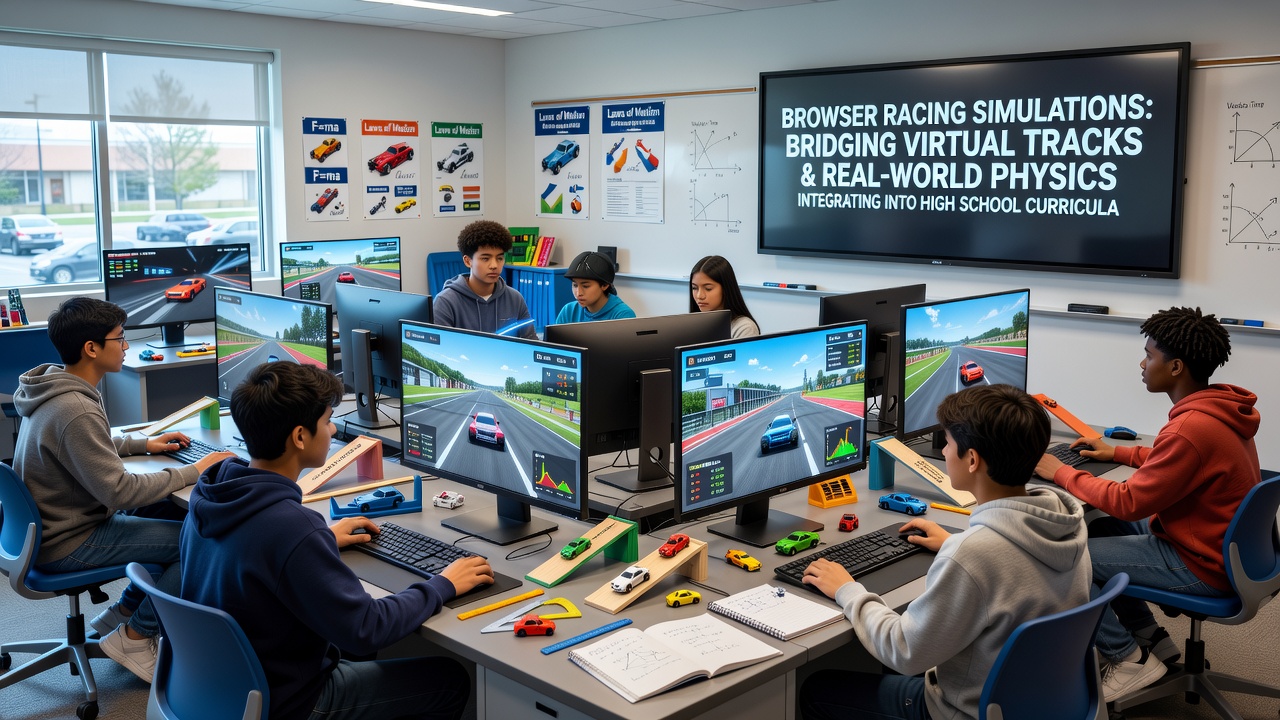
Browser racing simulations have found their way into high school physics classrooms where students access virtual tracks through standard web browsers to examine principles such as velocity, acceleration, and friction without specialized hardware or software installations. These platforms allow users to adjust variables including tire grip, vehicle mass, and track incline while the underlying code applies Newtonian mechanics in real time. Researchers at institutions across North America and Europe have documented how such tools align with existing curriculum standards that emphasize experimental design and data analysis.
Core Mechanics and Educational Alignment
Physics instructors integrate browser-based racing environments by assigning tasks where learners modify parameters like downforce and engine torque then observe resulting lap times and cornering forces. Data logs generated during sessions feed directly into spreadsheet software for calculation of average speeds and centripetal accelerations, which match formulas taught in standard textbooks. A 2024 report from the Australian Council for Educational Research noted measurable alignment between simulation outputs and laboratory measurements collected with low-cost motion sensors on model cars.
Students often begin with preset tracks that replicate real-world circuits before progressing to custom layouts they design using simple coordinate inputs. This progression reinforces concepts of projectile motion when vehicles leave the ground over jumps and energy conservation when braking distances vary with surface materials. Teachers report that the immediate visual feedback helps clarify why certain adjustments produce predictable changes in performance metrics.
Implementation Patterns Across Regions
School districts in Canada began piloting these simulations during the 2023-2024 academic year as part of revised science guidelines that encourage digital tool use alongside physical experiments. European programs coordinated through the European Schoolnet network have since expanded access, providing multilingual interfaces that support collaborative sessions where teams in different countries compare results from identical virtual setups. In June 2026 several Canadian provinces plan to release updated assessment rubrics that incorporate simulation-derived datasets as acceptable evidence of mastery for kinematics units.
Training modules for educators typically cover how to calibrate virtual sensors so that displayed g-forces correspond to documented values from professional motorsport telemetry. This calibration step ensures students treat the browser environment as a controlled experiment rather than a game, prompting them to record independent variables systematically before altering conditions again.
Physics Concepts Reinforced Through Simulation
Key topics addressed include conservation of momentum during simulated collisions, effects of air resistance on terminal velocity, and the relationship between normal force and maximum static friction on banked curves. When learners increase virtual vehicle weight, they record longer stopping distances that follow the same inverse-square patterns observed in real braking tests conducted by transportation agencies. Figures released by the U.S. National Science Foundation indicate that classes using these tools showed higher accuracy in predicting outcomes on subsequent paper-based problems compared with control groups relying solely on textbook examples.
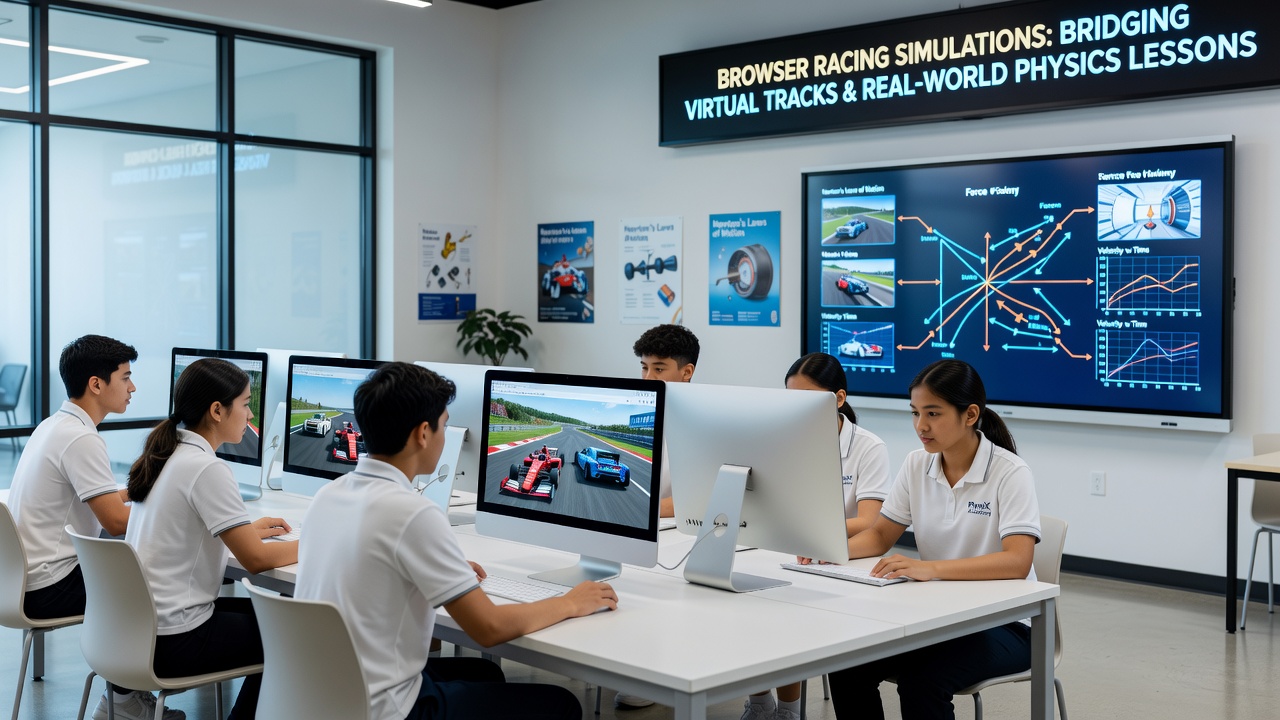
Randomized weather conditions within the simulations introduce variability that mirrors outdoor lab challenges, forcing students to account for reduced traction on wet surfaces or altered aerodynamics in crosswinds. Such features encourage repeated trials and statistical analysis, practices emphasized in next-generation science standards adopted by multiple U.S. states. Observers note that the low barrier to entry allows schools without dedicated computer labs to run sessions on shared devices during regular class periods.
Data Collection and Assessment Integration
Many platforms export time-stamped position and velocity data that students import into analysis tools for linear regression of speed versus time graphs. These exports have become accepted alternatives to manual stopwatch measurements in some districts, provided learners document their methodology and identify potential sources of digital rounding error. A study conducted at a Finnish teacher training university found that students who completed five simulation sessions demonstrated improved ability to interpret slope and intercept values on velocity-time graphs compared with peers who performed only traditional inclined-plane experiments.
Assessment rubrics now frequently require learners to design a virtual experiment that isolates one variable while holding others constant, then present both simulation results and mathematical predictions side by side. This dual-evidence approach satisfies requirements for both computational thinking and empirical validation within a single assignment cycle.
Future Developments Scheduled for 2026
Developers collaborating with curriculum specialists aim to add real-time multiplayer modes by June 2026 that let geographically separated classes race identical vehicle configurations and directly compare telemetry streams. Pilot versions already allow overlay of multiple data sets on shared graphs, highlighting small differences caused by network latency or browser rendering variations. Such features are expected to support larger-scale comparative studies across school networks without additional equipment costs.
Conclusion
Browser racing simulations continue to supply high schools with accessible environments where abstract physics equations gain immediate visual and numerical representation. As more regions adopt digital components into science requirements and refine assessment methods around exported data sets, these tools occupy an expanding role alongside traditional laboratory work. Continued coordination between software creators, teacher networks, and standards organizations will determine how broadly the approach scales in upcoming academic years.